

Ozone is a powerful oxidant used in water treatment, wastewater treatment, swimming pool purification, and industrial oxidation processes. However, ozone generation alone does not guarantee effective treatment results. The key challenge is transferring ozone gas into water efficiently before ozone naturally decomposes.
Many ozone systems experience lower-than-expected performance because of poor gas-liquid contact, unsuitable injection methods, or incorrect system design. As an ozone equipment manufacturer, Feili focuses on improving the complete ozone utilization process, from ozone generation to injection and mixing.
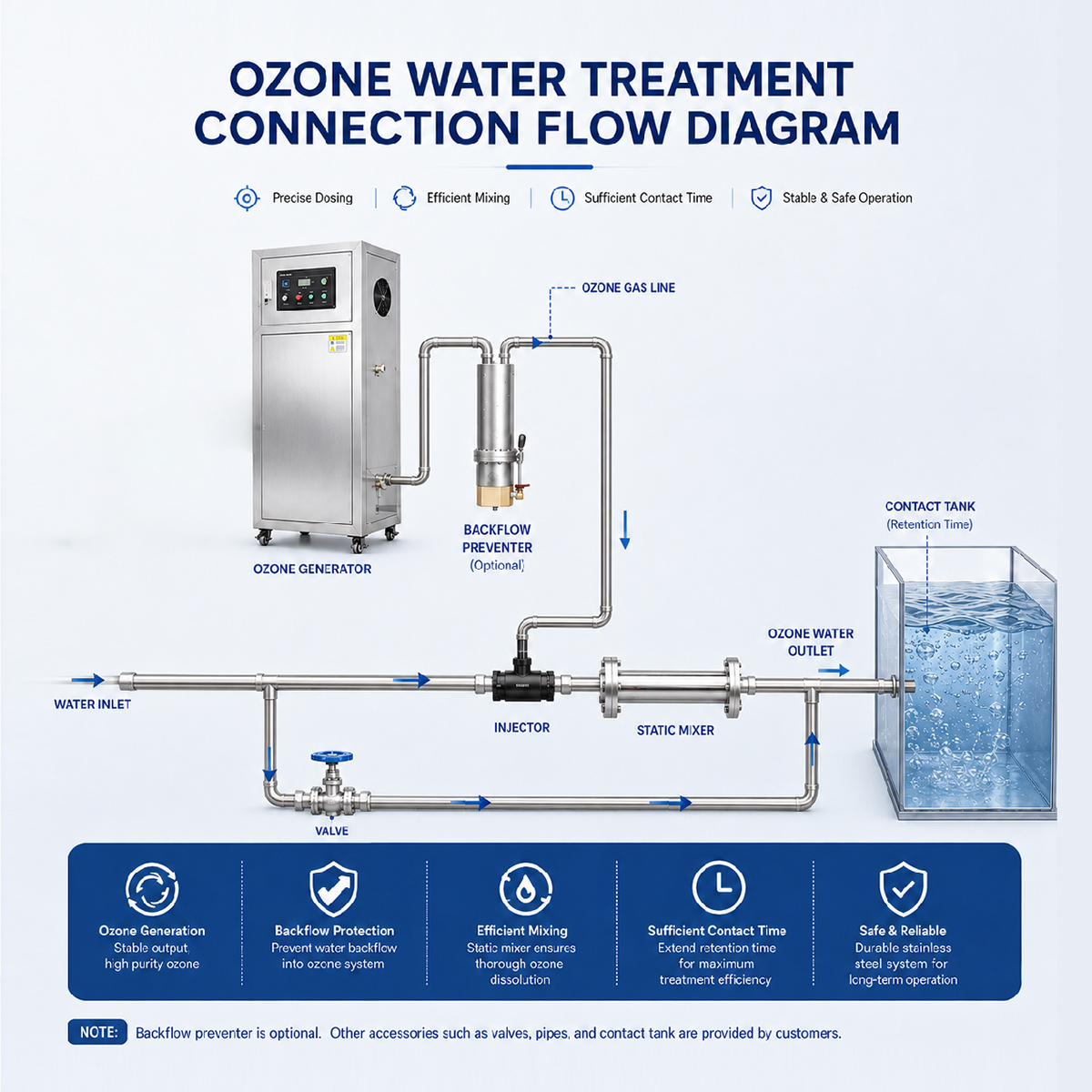
A well-designed Ozone Venturi Injector System helps increase ozone dissolution by creating a strong vacuum effect that draws ozone gas into the water stream and improves contact between gas bubbles and liquid.
Understanding Ozone Transfer Efficiency
Ozone transfer efficiency refers to the percentage of ozone successfully dissolved into water compared with the total ozone produced. The higher the transfer efficiency, the more ozone participates in oxidation reactions.
| Factor | Effect On Ozone Transfer |
| Bubble Size | Smaller bubbles provide larger contact surface area |
| Water Pressure | Higher pressure improves ozone absorption capacity |
| Gas Concentration | Higher ozone concentration affects dissolution speed |
| Contact Time | Longer contact allows more ozone reaction |
According to water treatment engineering studies, ozone transfer efficiency in practical systems commonly ranges from approximately 70% to 90% depending on injector performance, water characteristics, and contact chamber design.
Common Reasons For Low Ozone Transfer Efficiency
Several installation and operating conditions can reduce ozone absorption:
- Insufficient pressure difference across the injector
- Incorrect injector size compared with water flow
- Large ozone bubbles escaping before dissolution
- High water temperature reducing ozone solubility
- Poor contact chamber design
Water temperature has a significant influence on ozone solubility. Scientific research shows that ozone dissolves more easily in colder water, while warmer water accelerates ozone decomposition.
How To Improve Ozone Transfer Efficiency
Improving ozone transfer requires optimizing the entire gas-liquid mixing process rather than replacing only one component.
- Select an injector matching the actual water flow rate
- Maintain sufficient inlet and outlet pressure difference
- Use proper piping design to reduce pressure loss
- Increase contact time when required
- Monitor dissolved ozone concentration during operation
A professional Venturi Ozone Systems Supplier evaluates these factors before recommending a suitable configuration. The goal is to maximize ozone reaction efficiency while reducing unnecessary ozone consumption.
The Role Of Venturi Injector Design In Ozone Systems
Venturi injectors work according to the Venturi effect. When water passes through a narrow section of the injector, velocity increases and pressure decreases, creating suction that pulls ozone gas into the water stream.
The injector design directly affects suction capacity, mixing stability, and long-term reliability. Materials also matter because ozone is highly reactive and requires ozone-resistant components.
For example, PVDF materials are widely used in ozone-related applications because of their excellent chemical resistance and durability.
Applications Requiring Better Ozone Mixing
Efficient ozone transfer is especially important in:
- Industrial wastewater oxidation
- Drinking water treatment
- Swimming pool ozone purification
- Food processing water treatment
- Aquaculture water management
In these applications, integrating ozonation water treatment technology with proper injection equipment helps achieve more stable oxidation performance.
Final Thoughts On Ozone Mass Transfer Optimization
Low ozone transfer efficiency is usually caused by system design limitations rather than ozone generation capacity alone. Proper injector selection, accurate hydraulic calculation, and optimized mixing conditions are essential for achieving reliable ozone treatment results.
